
Appomattox County Court Records After Arrest
A jail arrest and a court case are linked, but they are not the same record. The BRRJA roster identifies custody after booking. Appomattox County court records after a jail arrest track the criminal case that follows. The official county court-system page identifies Circuit Court, General District Court, and Juvenile and Domestic Relations District Court. The Commonwealth's Attorney prosecutes felony and misdemeanor cases in those courts for Appomattox County and the Commonwealth of Virginia.
The usual path is arrest or warrant service, jail booking, magistrate or first appearance, prosecutor review, then a court case with charges and hearing activity. The court case may show a case number, defendant name, charge list, code section, hearing dates, disposition, fines, costs, and sometimes attorney or bond information depending on the court and portal. For the custody side, use Appomattox County jail inmate records. For booking photos, use Appomattox County jail mugshots.
Search Court Records After Arrest
Virginia court case information is spread across several official systems. The Virginia courts case information hub links to OCIS, Circuit Court, General District Court, and Juvenile and Domestic Relations District Court information. OCIS is a statewide adult criminal case search landing point, while General District and Circuit systems differ by court. Juvenile and Domestic Relations Court information is not available online because of confidentiality rules.
The Virginia case-status hub is the official starting screen for court records after an Appomattox County jail arrest.
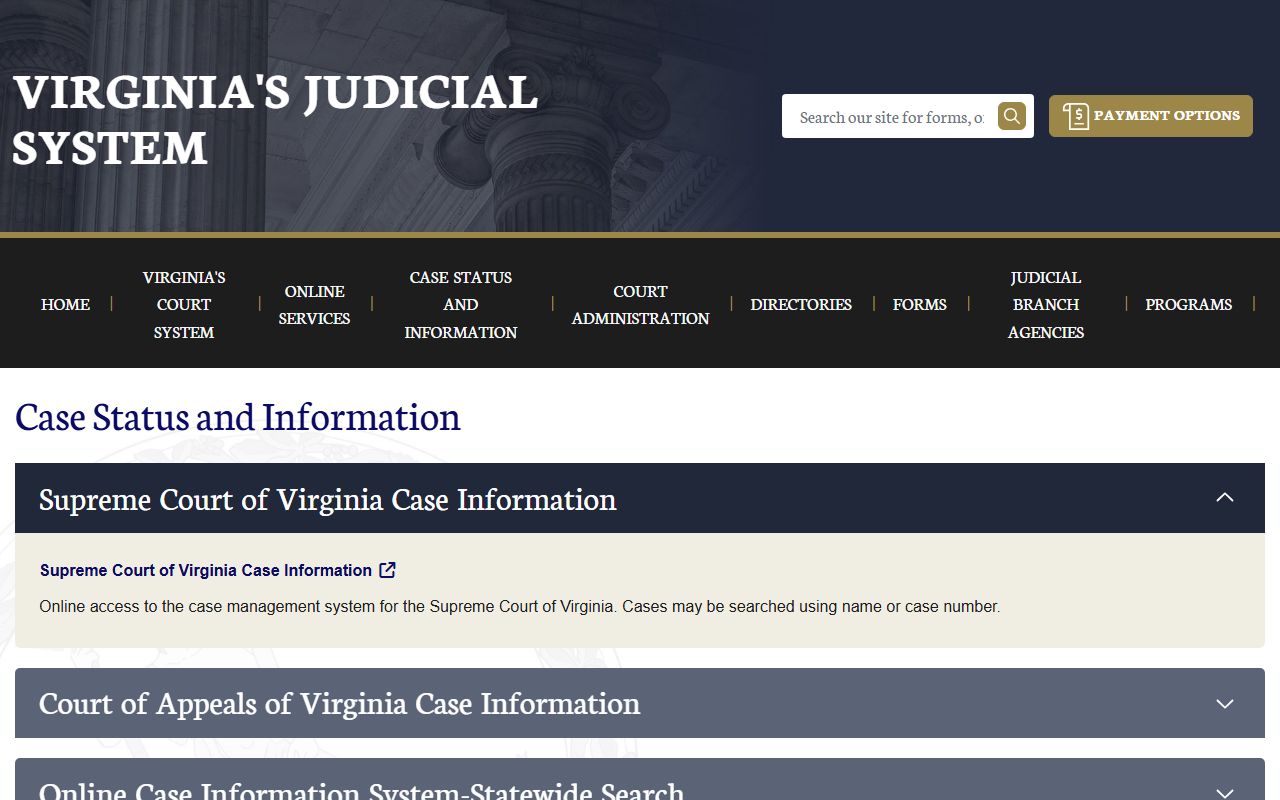
Use the hub to choose the correct court system before treating a no-match result as final.
- Open the statewide case information hub or OCIS and choose the criminal case search path.
- Select Appomattox or the appropriate court locality when the portal asks for a court or locality.
- Search by defendant name first, or use the case number if it appears on court papers, a summons, or a notice.
- Open the case and read each charge, charge level, hearing date, status, disposition, and bond entry.
- For missing, older, certified, or sealed file questions, contact the Appomattox Circuit Court Clerk rather than relying on a web result alone.
Appomattox Court Records Search Fields
The available search fields depend on the court system. Research found that Virginia court systems can support locality, name, case number, hearing date, and statewide OCIS paths. Use a broad name search first if the case number is unknown, then narrow by court, date, or charge once the record appears.
| Field Label | Type | Required | Options or Notes |
|---|---|---|---|
| Court or locality | Dropdown | Yes | Select Appomattox or the specific court/locality. Circuit and General District systems differ. |
| Name | Text | Optional path | Search by defendant name where the portal supports it. |
| Case Number | Text | Optional path | Best when known from paperwork, warrant, summons, or a court notice. |
| Hearing Date | Date | Optional path | Useful when a family knows the first appearance, preliminary hearing, or trial date. |
| Statewide OCIS | Web portal | Varies | Provides adult criminal case information, but cannot be used for payments. |
| General District case info | Web portal | Varies | Locality access for civil, criminal, and traffic cases, including online payments. |
Appomattox County Courts After Arrest
Appomattox County criminal matters can involve more than one court. General District Court commonly handles misdemeanors, traffic matters, and early felony stages such as preliminary hearings. Circuit Court handles felony trials, indictments, appeals from lower courts, and many record-file functions through the Clerk of Circuit Court. Juvenile and Domestic Relations District Court handles juvenile and family-related matters, but online case information is not available for JDR cases because of confidentiality.
The Appomattox Circuit Court Clerk maintains court files and criminal and civil records. The clerk's office is at 297 Court Street, Suite B, Appomattox, VA 24522; phone 434-352-5275; hours Monday-Friday 8:30 a.m.-4:30 p.m. Clerk and FOIA Officer Janet A. Hix is listed in the county directory. Certified copies, older files, and records that do not appear in an online portal should be handled through the clerk rather than through the jail.
Note: Virginia self-help materials state that JDR case information is not available online due to confidentiality.
Charges Filed After Arrest
After a jail arrest, the prosecutor may proceed on charges shown in a complaint, information, indictment, or amended charging document. A booking charge can be a starting point, but it may not match the final filed charge. Felony cases may begin in General District Court and later move to Circuit Court by indictment or certification. Misdemeanor matters may stay in lower court unless an appeal or related felony changes the path.
| Document | Who Uses It | What It Does |
|---|---|---|
| Complaint | Law enforcement or prosecutor | Sets out the alleged offense that begins or supports the criminal case. |
| Information | Prosecutor | Formal charging paper used by the prosecution when allowed by procedure. |
| Indictment | Grand jury | Charges a felony or serious matter for Circuit Court prosecution. |
Appomattox Court Charge Status
Charge status can change many times after an arrest. A prosecutor may amend or reduce a charge. A court may dismiss a charge. A nolle prosequi means the prosecutor declined to proceed at that time, which is different from an acquittal. A conviction means guilt was found by the court or accepted through a plea. Always read each charge line separately because one case can contain several charges with different outcomes.
| Status | Meaning |
|---|---|
| Pending | The charge is unresolved and still active in court. |
| Amended or reduced | The prosecutor or court changed the charge, level, or wording. |
| Dismissed | The charge ended without a conviction on that count. |
| Nolle prosequi | The prosecutor chose not to proceed at that time. |
| Convicted or guilty | The court found guilt or accepted a guilty plea. |
| Acquitted or not guilty | The court found the defendant not guilty of that charge. |
Bond Records After Arrest
Bond is addressed by a magistrate or judge after arrest. Virginia does not use one Appomattox-specific bail schedule in the research. Release may be personal recognizance, unsecured bond, secured or cash bond, surety bond through a licensed bail bondsman, or no-bond status. A jail roster may show bond or hold information if the public profile exposes it, but the court case should be checked for formal bond orders and later changes.
| Bond Type | How It Works |
|---|---|
| Personal recognizance | Release based on a promise to appear, often with conditions. |
| Unsecured bond | A bond amount is set but not paid upfront unless conditions are violated. |
| Secured or cash bond | Money or security must be posted before release. |
| Surety bond | A licensed Virginia bondsman posts bond for fee or collateral. |
| No-bond hold | Release is blocked until a court changes status or another hold clears. |
Warrants and Court Records
No official Appomattox County active-warrant search database was located. The sheriff's office does serve criminal warrants and civil process, and court records may show pending criminal or traffic matters, failure-to-appear entries, capias activity, or case numbers once a matter reaches court. Social media wanted posts can change and should not be treated as a complete database.
Warrant-related questions can be routed to the Appomattox County Sheriff's Office at 179 Morton Lane, phone 434-352-2666, during administrative hours. Court search systems can help find cases after charges are filed. The clerk can address circuit criminal records and court files. The Commonwealth's Attorney handles prosecution and victim-witness matters, but not legal advice for a defendant. People who think they have an active warrant should speak with a lawyer or the court because appearing at law enforcement can result in arrest.
Commonwealth's Attorney Charge Role
Virginia uses the title Commonwealth's Attorney rather than District Attorney. The Appomattox County Commonwealth's Attorney prosecutes felony and misdemeanor cases in Circuit, General District, and Juvenile and Domestic Relations District Courts. The office is at 297 Court Street, Suite A, Appomattox, VA 24522; phone 434-352-7627; hours Monday-Friday 8:30 a.m.-4:30 p.m. Current county directory information lists Leslie M. Fleet as Commonwealth's Attorney.
After a jail arrest, the prosecutor may file charges, amend the charge level, reduce a charge, dismiss a charge, or proceed through preliminary hearing, indictment, plea, trial, or sentencing. Victim-witness services may help victims follow court activity and can work alongside VINE custody notifications. Prosecutor records are not a substitute for the court docket, and the office does not provide defense advice.
Charges Versus Convictions
A charge is an accusation in a court record after arrest. A conviction is a final finding or accepted plea of guilt. This distinction matters for Appomattox County court records because a roster entry or pending charge does not prove guilt. Read the disposition field before treating a case as finished.
| Issue | Charge | Conviction |
|---|---|---|
| Stage | Accusation after arrest or filing | Outcome after plea, verdict, or finding |
| Proof level | Based on allegation and probable cause path | Based on guilt found or admitted under court rules |
| Can change | May be amended, reduced, dismissed, or not prosecuted | May affect sentence, fines, costs, and criminal-history treatment |
| Where seen | Jail roster and court case may both show charge clues | Court disposition and criminal-history systems are the proper source |
Sealed and Expunged Records
Virginia public access laws allow many court and law-enforcement records to be inspected, but they also contain exceptions. Juvenile matters, sealed cases, protected information, and active investigative records may be restricted. Code of Virginia section 2.2-3704.01 requires release of nonexempt portions when a record contains both open and excluded information. Code of Virginia section 19.2-392.2 governs expungement for qualifying police and court records.
| Issue | Sealed | Expunged |
|---|---|---|
| Public view | Hidden or restricted from public access by court rule or order. | Removed from public access for qualifying outcomes under Virginia law. |
| Record holder | Court or agency may retain limited-access files. | Police and court records can be affected if the court grants relief. |
| Eligibility | Depends on case type, court order, and confidentiality rule. | Depends on the disposition and statutory requirements. |
| Next step | Ask the clerk about access limits. | Review the statute and court process or consult counsel. |
Criminal History Limits
A court search is not the same as a formal statewide criminal-history record. Code of Virginia section 19.2-389 controls dissemination of criminal-history record information to authorized people and agencies. A casual online case lookup may show public case data, but it should not be used as a substitute for a lawful background-check process.
Important: Court, jail, and booking information may not be used for employment, housing, credit, insurance, or another FCRA-covered decision.